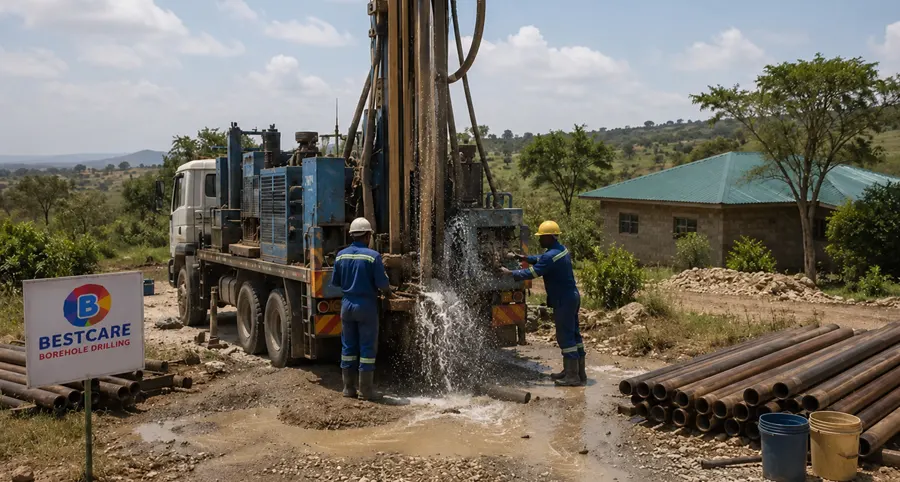
Cable tool percussion borehole drilling is a proven method of drilling water wells, particularly in areas where reliable groundwater access is essential. Unlike rotary drilling systems that continuously rotate a drill bit, cable tool drilling uses a heavy drilling tool that repeatedly strikes and breaks the rock or soil at the bottom of the borehole. This straightforward technique has been used for generations and remains a practical option for water well construction.
What Is Cable Tool Percussion Borehole Drilling?
Cable tool percussion borehole drilling involves a heavy drill bit or drilling tool suspended from a cable. The drilling machine repeatedly raises and drops the tool into the borehole. The impact breaks, loosens, and pulverizes the geological formation. The broken material is periodically removed using a bailer or similar tool.
The process continues until the required borehole depth is reached. Depending on the geological conditions, temporary casing may be installed to prevent the borehole walls from collapsing during drilling.
How Cable Tool Drilling Works
The basic operation of a cable tool drilling rig is relatively simple. A winch and cable raise the drilling tool before allowing it to fall under gravity. Repeated impacts gradually penetrate the ground.
When drilling through loose formations, a casing can help stabilize the borehole. Water may also be introduced into the hole to create a slurry, allowing the loosened material to be removed more effectively. A bailer is then lowered into the borehole to collect and remove the drilling debris.
Once the target aquifer is reached, the borehole can be developed and fitted with appropriate casing, screens, and a pumping system.
Advantages of Cable Tool Borehole Drilling
One of the main advantages of cable tool borehole drilling is its relatively simple mechanical design. Because the equipment has fewer complicated components than many modern rotary systems, maintenance can be straightforward, and operators can often perform repairs locally.
Cable tool rigs can also be effective in a wide range of geological formations. They are particularly useful for drilling water wells where careful formation identification and sampling are important. The drilling process produces relatively clear formation samples, which can help operators understand changes in underground geology and identify potential water-bearing zones.
Another advantage is that cable tool rigs can have lower operating requirements compared with some larger rotary drilling systems, making the method attractive for selected borehole projects.
Limitations of Cable Tool Percussion Drilling
Despite its advantages, cable tool drilling is generally slower than modern rotary drilling methods, especially when drilling deep boreholes or hard rock formations. The process also requires regular removal of cuttings, which can increase drilling time.
Site conditions, borehole depth, geological formation, equipment capacity, and operator experience all influence drilling performance. For challenging projects, a professional borehole contractor should assess the site before selecting the most suitable drilling technique.
Applications of Cable Tool Drilling
Cable tool percussion drilling is commonly associated with water well construction, groundwater exploration, environmental sampling, and some shallow-to-medium-depth borehole projects. It can be especially useful where durable, relatively simple drilling equipment is preferred.
Cable tool percussion borehole drilling remains a dependable method for constructing water wells and exploring groundwater resources. Its simple operating principle, robust equipment, and ability to provide useful geological samples make it valuable for specific drilling conditions. Although modern rotary methods may offer greater speed, cable tool drilling continues to be a practical solution where its advantages match the requirements of the project.