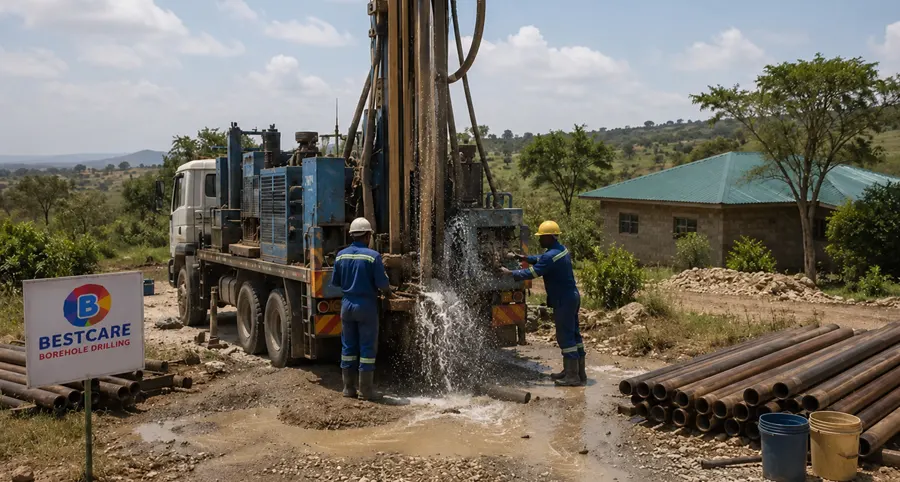
A borehole that was producing clean, strong water two years ago can quietly turn into a weak, silty, or foul-smelling supply without any obvious cause. Most of the time the problem isn’t the aquifer, it’s the borehole itself. Sediment builds up at the bottom, biofilm and mineral scale coat the screen slots, and the whole system starts choking on its own buildup. Borehole cleaning through airlifting and jetting is the standard fix, and it’s far cheaper than assuming the borehole has failed and starting over.
Bestcare Borehole Drilling handles this as a dedicated service because so many “failed” boreholes we’re called out to inspect aren’t actually dead, they’re just clogged. A proper cleaning and jetting job can restore yield that everyone assumed was gone for good.
Processes Involved in Borehole Cleaning, Airlifting, and Jetting
| # | Process | Purpose |
|---|---|---|
| 1 | Borehole Inspection & Video Logging | Identify blockage location, screen condition, and sediment depth |
| 2 | Airlifting | Remove loose sediment and flush the borehole using compressed air |
| 3 | Surge Block Jetting | Dislodge encrusted material from screen slots and gravel pack |
| 4 | High-Pressure Water Jetting | Clear stubborn mineral scale and biofilm from casing and screen |
| 5 | Bailing & Sediment Removal | Physically remove loosened debris from the bottom of the borehole |
| 6 | Post-Cleaning Yield Test | Confirm recovery in yield and water clarity after cleaning |
1. Borehole Inspection & Video Logging
Before any cleaning begins, we lower a downhole camera to inspect the casing, screen, and sediment buildup directly. This tells us exactly where the problem sits, whether it’s collapsed casing, scaled screen slots, or simply a thick layer of settled sediment at the base. Cleaning without this step means working blind and often means paying for a technique that isn’t suited to the actual problem.
2. Airlifting
Airlifting works by injecting compressed air down a pipe into the borehole, which creates a strong upward surge that lifts loose sediment, sand, and debris to the surface. It’s typically the first active cleaning step because it clears the bulk of loose material before more targeted techniques go to work on what’s left stuck to the screen and casing walls.
3. Surge Block Jetting
A surge block is lowered and moved up and down through the water column to create a plunger-like pumping action. This forces water in and out of the screen slots repeatedly, which is often the only way to dislodge fine sediment and encrustation that’s worked its way into the gravel pack surrounding the screen, material that airlifting alone can’t reach.
4. High-Pressure Water Jetting
Mineral scale and biofilm buildup, particularly iron and manganese deposits, can cement themselves onto the screen and casing over time. High-pressure jetting blasts these deposits loose using targeted water pressure, often combined with a rotating jetting tool that works around the full circumference of the casing rather than just one side.
5. Bailing & Sediment Removal
Once material has been loosened by airlifting and jetting, it settles back at the bottom of the borehole and needs to be physically removed with a bailer. Skipping this step means the borehole looks clean on paper but still has a sediment load sitting at the base, ready to stir back up the moment the pump switches on.
6. Post-Cleaning Yield Test
The job isn’t complete until we run a yield test to confirm the cleaning actually worked. This means checking pumping rate, water clarity, and drawdown recovery against the borehole’s original performance data where available, so the client has real numbers showing the improvement rather than a general assurance that things look better.
Estimated Cost of Borehole Cleaning, Airlifting, and Jetting Services
| Service | Estimated Cost (KES) |
|---|---|
| Inspection & video logging | 8,000 – 15,000 |
| Airlifting (per session) | 15,000 – 30,000 |
| Surge block jetting | 12,000 – 25,000 |
| High-pressure water jetting | 20,000 – 40,000 |
| Bailing & sediment removal | 8,000 – 15,000 |
| Full cleaning package (all stages) | 45,000 – 90,000 |
Costs vary with borehole depth, sediment severity, and access to the site.
Frequently Asked Questions
1. How do I know if my borehole needs cleaning rather than a new drill? A drop in yield, cloudy or gritty water, or a pump that’s straining more than usual are strong signs the borehole is clogged rather than dry. An inspection will confirm this before you commit to expensive re-drilling.
2. How often should a borehole be cleaned? Most boreholes benefit from cleaning every 3 to 5 years, though heavy-use boreholes or those in iron-rich groundwater areas may need it sooner.
3. Will cleaning damage an old borehole? Cleaning is done with techniques matched to the borehole’s condition. Older or weaker casings are handled more conservatively to avoid causing further damage.
4. Can cleaning fix a borehole that’s completely dried up? If the drop is due to sediment blockage, yes. If the aquifer itself has dropped or depleted, cleaning won’t restore water that isn’t there anymore, which is why inspection comes first.
5. How long does the cleaning process take? Most standard cleaning jobs are completed in a single day, though heavily silted or deep boreholes may take two.
5 Reasons to Choose Bestcare Borehole Drilling
- Camera inspection before action — we diagnose the actual problem before choosing a technique, instead of jetting blindly and hoping.
- Full technique range in-house — airlifting, surge jetting, and high-pressure jetting are all handled by our own crew, no subcontracting delays.
- Data-backed results — yield testing before and after gives clients proof the cleaning actually worked.
- Experience with older boreholes — we know how to clean aging casing without pushing it past what it can handle.
- Faster and cheaper than re-drilling — in most cases we resolve what clients assumed was a dead borehole for a fraction of the cost of starting over.