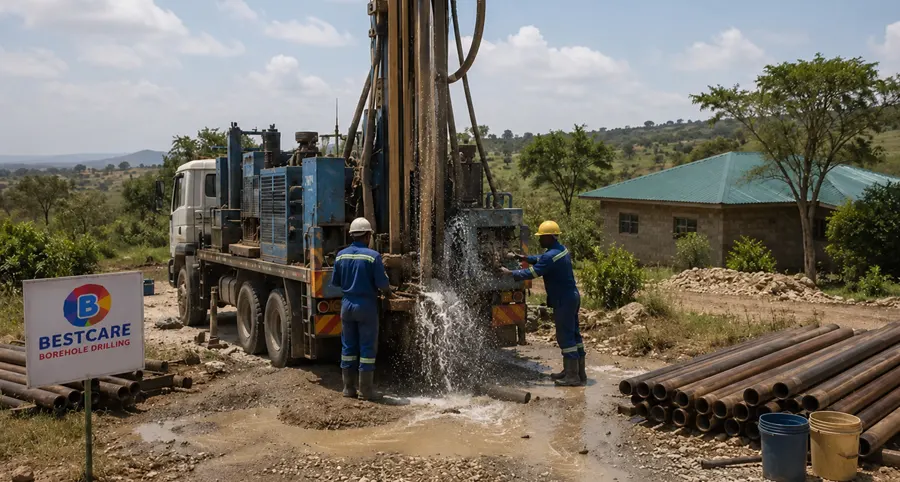
Nakuru Borehole Drilling and Water Storage Facilities Services
Reliable water supply is essential for homes, farms, institutions, commercial buildings, hotels and industrial facilities. In Nakuru, borehole water provides an important alternative or supplementary source where municipal supply is unreliable, insufficient or unavailable. However, successful borehole development requires much more than simply drilling into the ground. It involves hydro-geological investigation, regulatory approvals, professional drilling, well casing, development, water testing, pump installation and an appropriate water storage system.
Nakuru Borehole Drilling and Water Storage Facilities Services by Bestcare Borehole Drilling provide an integrated approach to groundwater development, from preliminary assessment and licensing to borehole construction, pumping systems and water storage facilities.
Industry insight: A properly designed borehole is an engineered water-supply system. The quality of the hydro-geological investigation, borehole construction, pump selection and storage design can significantly affect the reliability and operating cost of the installation.
Borehole Drilling Services in Nakuru
Borehole drilling involves creating a deep, engineered well to access underground water-bearing formations. Because groundwater conditions vary considerably from one location to another, drilling should begin with professional investigation rather than relying on assumptions based on nearby boreholes.
Bestcare Borehole Drilling can provide borehole development services for:
- Residential homes and estates
- Apartments and gated communities
- Hotels and lodges
- Schools and universities
- Hospitals and healthcare facilities
- Farms and agricultural projects
- Commercial premises
- Manufacturing and industrial facilities
- Institutions and community water projects
The borehole design is influenced by the expected water demand, geological conditions, anticipated depth, aquifer characteristics and intended pumping rate.
Prerequisite Licenses, Approvals and Compliance
Before drilling begins, the project must comply with applicable Kenyan water-resource and environmental requirements. The exact approvals required can depend on the location, project type and intended water use.
The process may involve engagement with the relevant water-resource authorities and obtaining the appropriate authorization for groundwater exploration and abstraction. Environmental considerations may also apply depending on the project.
A professional contractor helps the client understand the documentation and approval process before heavy drilling equipment is mobilized.
Important: Regulatory compliance should be treated as part of borehole development rather than an administrative afterthought. Starting drilling without the required approvals can expose a project to delays, additional costs and regulatory problems.
Hydro-Geological Survey and Groundwater Investigation
The hydro-geological survey is one of the most important stages of a borehole project. Its purpose is to identify areas where groundwater is likely to occur and recommend an appropriate drilling location and depth.
A professional hydro-geological investigation may consider:
- Geological formations in the area
- Existing borehole information
- Groundwater occurrence
- Surface drainage and topography
- Fractures and geological structures
- Expected aquifer zones
- Possible groundwater quality concerns
- Recommended drilling depth
- Expected yield
- Recommended borehole construction specifications
Geophysical techniques may be used to identify promising subsurface formations. The resulting report provides the basis for deciding where drilling should take place.
Borehole Drilling Process
After the site has been investigated and the necessary approvals obtained, drilling equipment is transported to the selected location.
The typical process includes:
1. Site Preparation
The drilling area is cleared and prepared for equipment. Access, safety and equipment positioning are considered before drilling starts.
2. Pilot Hole Drilling
The drilling rig penetrates the ground through successive geological formations. Drilling samples and formation observations help identify changes in the subsurface.
3. Identification of Aquifer Zones
During drilling, water-bearing formations are identified. Drilling continues to the planned depth or until a suitable groundwater-bearing formation is reached.
4. Borehole Casing Installation
Well casing is installed to stabilize the borehole and prevent loose formations from collapsing into the well. Casing specifications depend on the geological conditions and borehole design.
5. Installation of Screens
Where required, screened sections allow groundwater to enter the borehole while helping restrict the movement of formation material into the well.
6. Gravel Packing
Appropriately graded gravel may be placed around screened sections to provide additional filtration and structural support.
7. Sanitary Sealing
The borehole is sealed appropriately to reduce the risk of surface contaminants entering the groundwater system.
8. Borehole Development
Development removes drilling residues, fine particles and other materials introduced during construction. This helps improve water clarity and borehole performance.
9. Test Pumping
A pumping test determines the borehole’s sustainable yield and provides important information for selecting the correct pump.
10. Water Quality Testing
A water sample should be submitted for laboratory analysis. Testing can establish whether the water is suitable for domestic, agricultural, commercial or other intended uses and whether treatment is necessary.
Professional recommendation: Pump capacity should not be selected solely according to the depth of a borehole. The sustainable yield, static water level, pumping water level, required pressure and daily water demand should all be considered.
Borehole Pump and Water System Installation
Once the borehole has been completed and tested, the appropriate pumping system can be installed. Depending on the project, this may include a submersible pump, rising main, control panel, electrical protection equipment, level controls and associated pipework.
Solar-powered pumping systems can also be considered for sites where grid electricity is unavailable or where reducing electricity consumption is a priority.
The pump should be sized according to the borehole’s tested characteristics and the requirements of the water distribution and storage system.
Water Storage Facilities Installation and Construction
A borehole is only one component of a complete water-supply system. Proper storage ensures that water is available when demand exceeds the instantaneous pumping capacity or when power interruptions affect pumping.
Bestcare Borehole Drilling provides water storage solutions including:
- Plastic water tank installation
- Steel water tank installation
- Concrete water reservoir construction
- Elevated water tanks
- Ground-level storage tanks
- Commercial water storage systems
- Institutional water storage systems
- Farm and irrigation storage
- Water tower construction
- Pump-to-tank systems
- Tank-to-building distribution systems
Water Tower Installation
Water towers elevate storage tanks to create pressure through gravity. They can be particularly useful for buildings, institutions, farms and facilities that require reliable water distribution without continuously operating a booster pump.
A water tower should be structurally designed according to tank capacity, tower height, loading requirements, foundation conditions and site characteristics.
Water Tank Installation
Tank installation involves selecting an appropriate tank capacity, preparing the base, positioning the tank and connecting inlet, outlet, overflow, drain and distribution pipework.
Tank size should be determined according to the number of users, daily demand, borehole yield, available pumping hours and required emergency reserve.
Water Storage Facilities Repair and Maintenance
Storage infrastructure requires periodic inspection and maintenance. Problems such as leaking tanks, damaged pipework, blocked outlets, corroded steel structures, faulty valves and inadequate tank supports can affect water availability.
Maintenance services can include:
| Maintenance Service | Typical Work |
|---|---|
| Tank inspection | Checking cracks, leaks, fittings and structural condition |
| Tank cleaning | Removal of sediment, dirt and accumulated deposits |
| Leak repair | Repairing tanks, joints, valves and connecting pipes |
| Pipework maintenance | Replacing damaged or leaking sections |
| Water tower inspection | Checking supports, platforms, braces and connections |
| Valve replacement | Replacing faulty inlet, outlet and isolation valves |
| Tank base inspection | Checking stability and foundation condition |
| Pump maintenance | Inspection of pump, controls and electrical components |
| Float valve replacement | Restoring automatic tank filling |
| System pressure checks | Identifying distribution and pumping problems |
Regular maintenance can extend the service life of storage infrastructure and reduce the likelihood of unexpected water interruptions.
Maintenance insight: Water storage systems should be inspected periodically even when they appear to be functioning normally. Early detection of leaks, corrosion, structural deterioration and faulty valves is generally less disruptive than emergency repairs.
Estimated Cost of Borehole and Water Storage Services in Nakuru
Actual costs vary according to depth, geology, equipment requirements, water yield, materials, tank capacity, tower height, site accessibility and project specifications. The following figures are indicative estimates rather than fixed quotations.
| Service | Estimated Cost in Kenya (KES) |
|---|---|
| Hydro-geological survey and report | 25,000 – 60,000 |
| Geophysical groundwater survey | 20,000 – 50,000 |
| Borehole drilling | 6,000 – 12,000 per metre |
| Borehole casing and screens | 3,500 – 8,000 per metre |
| Gravel packing and sanitary sealing | 40,000 – 120,000 |
| Borehole development | 30,000 – 80,000 |
| Test pumping | 30,000 – 70,000 |
| Water quality laboratory testing | 8,000 – 25,000 |
| Submersible pump supply and installation | 100,000 – 350,000 |
| Solar borehole pumping system | 250,000 – 800,000+ |
| 5,000-litre water tank installation | 35,000 – 90,000 |
| 10,000-litre water tank installation | 60,000 – 150,000 |
| 20,000-litre water tank installation | 100,000 – 250,000 |
| Elevated water tower | 100,000 – 500,000+ |
| Concrete water reservoir | 150,000 – 700,000+ |
| Tank cleaning | 5,000 – 25,000 |
| Water tank leak repair | 5,000 – 50,000+ |
| Water tower repair and maintenance | 15,000 – 100,000+ |
| Borehole pump repair | 15,000 – 100,000+ |
A complete borehole project may therefore cost several hundred thousand shillings or more depending on drilling depth and infrastructure requirements. A site-specific quotation should be prepared after the technical assessment.
5 Reasons to Choose Bestcare Borehole Drilling
1. End-to-End Project Support
Bestcare Borehole Drilling can coordinate the major stages of groundwater development, helping clients avoid managing unrelated contractors for every stage.
2. Professional Site Assessment
The drilling location is selected based on technical investigation rather than guesswork, helping improve the prospects of developing a productive borehole.
3. Integrated Water Storage Solutions
The company can address both groundwater extraction and storage requirements, including tanks, towers, reservoirs and associated pipework.
4. Appropriate Equipment and Technical Approach
Borehole projects require suitable drilling, pumping, casing and testing equipment. Professional planning helps ensure that the infrastructure corresponds with the site’s requirements.
5. Maintenance and After-Service Support
A water system represents a long-term investment. Access to repair, inspection and maintenance services can help keep boreholes, pumps and storage facilities operational.
10 Frequently Asked Questions About Borehole Services in Nakuru
1. How deep are boreholes in Nakuru?
Borehole depths vary significantly depending on local geology and aquifer conditions. A hydro-geological survey provides a professional estimate before drilling.
2. How much does borehole drilling cost in Nakuru?
The cost depends mainly on drilling depth, geological conditions, casing requirements, testing and pumping equipment. Drilling is commonly priced per metre, while the complete project includes additional components.
3. Is a hydro-geological survey necessary?
Yes. It helps identify promising groundwater zones and provides technical information for planning the borehole.
4. How long does borehole drilling take?
The duration varies according to depth, ground conditions, equipment and project complexity. Additional time is required for development, testing and water analysis.
5. Can borehole water be used for drinking?
It can be, provided laboratory testing confirms that the water meets the applicable drinking-water quality requirements and any necessary treatment is installed.
6. What size water tank should I install?
Tank capacity should be based on daily consumption, number of users, borehole yield, pumping schedule and the desired reserve. Common residential and commercial capacities range from several thousand litres upward.
7. Can Bestcare install a water tower?
Yes. Water tower projects can include structural support, tank installation, pipework, valves and connection to the borehole or building distribution system.
8. Can an existing borehole be repaired?
In many cases, yes. Assessment can identify problems involving pumps, electrical systems, blocked screens, reduced yield, pipework or other components.
9. How often should a water tank be cleaned?
The appropriate interval depends on water quality and usage, but tanks should be inspected and cleaned periodically to control sediment and maintain hygienic storage.
10. Can borehole pumping be powered by solar energy?
Yes. Solar pumping can be an effective option where grid electricity is unavailable, unreliable or expensive. System sizing should be based on borehole yield, pumping requirements and daily water demand.
Reliable Groundwater and Water Storage Solutions
Nakuru Borehole Drilling and Water Storage Facilities Services by Bestcare Borehole Drilling combine groundwater investigation, regulatory preparation, professional drilling, borehole construction, pumping, water testing and storage infrastructure. The same approach can extend to water towers, tanks, reservoirs, repairs and ongoing maintenance.
For a new borehole or an existing water system that requires improvement, the most effective starting point is a professional site assessment. This allows the proposed borehole depth, expected groundwater conditions, pump requirements and storage capacity to be evaluated before major investment is made.