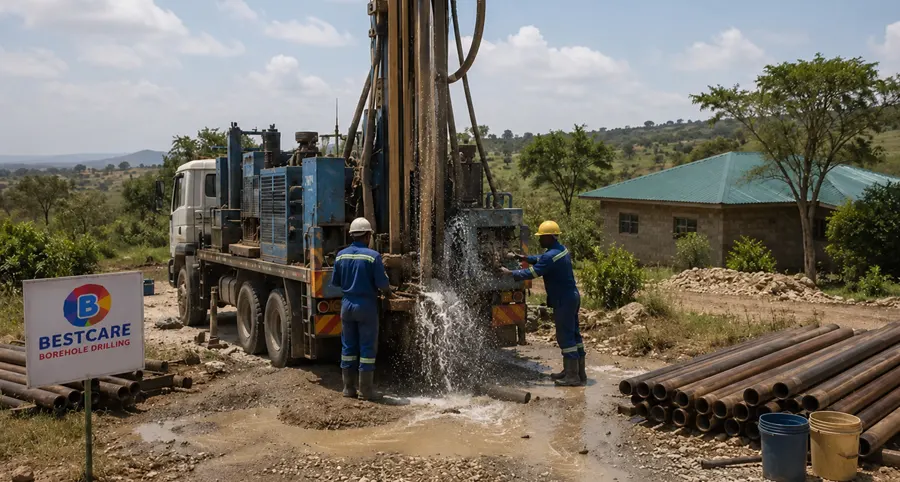
Before a single metre of ground is drilled, water must first be found on paper. A hydrogeological survey is the systematic study of groundwater occurrence, distribution, movement, and quality within a defined area. It is the intellectual backbone of any borehole project — the work that transforms a patch of land into a legible story of what lies beneath.
What a Hydrogeological Survey Involves
The process begins with a desk study: compiling and analysing all existing information about the area. This includes regional geological maps, published aquifer studies, records from nearby boreholes, soil surveys, topographic data, and climatic information on rainfall and evapotranspiration. In well-documented areas, this desk study alone can yield a strong preliminary picture of groundwater potential. In data-sparse regions — common across much of sub-Saharan Africa and rural Asia — it serves only as a starting framework.
Following the desk study, a field reconnaissance is carried out. The hydrogeologist visits the site to observe surface expressions of subsurface conditions: natural springs, seepage zones, vegetation patterns, drainage channels, and exposed rock outcrops. These features often betray the presence of fractures, faults, or permeable formations that may host groundwater.
Geological Mapping
Geological mapping documents the rock and soil types present at and near the surface, their spatial distribution, and their structural relationships — folds, faults, joints, and bedding orientations. Each rock type has characteristic water-bearing properties. Fractured basement rocks, alluvial sands and gravels, limestone karst systems, and weathered volcanic formations each behave very differently as aquifers.
Understanding the geology allows the hydrogeologist to predict not just where groundwater may exist, but at what depth, in what quantity, and of what likely quality. A borehole drilled into a poorly chosen formation may yield little water or water that is chemically unsuitable for use.
Aquifer Identification & Characterisation
Central to the hydrogeological survey is identifying which aquifer units are present and characterising their properties. Key parameters include:
- Hydraulic conductivity — how easily water moves through the formation
- Porosity and storativity — how much water the formation can hold and release
- Aquifer thickness and lateral extent — the physical dimensions of the water-bearing zone
- Recharge mechanisms — how and where rainfall replenishes the aquifer
This characterisation draws on borehole logs from nearby wells, geological cross-sections, and any available pumping test data from the region.
Groundwater Quality Mapping
Hydrogeological surveys also assess spatial patterns in groundwater quality. Certain geological formations are known to release specific contaminants into groundwater — fluoride from volcanic rocks, arsenic from alluvial sediments, iron and manganese from reducing environments. Mapping these geological risk zones informs decisions about where to drill and what treatment, if any, the water will require.
Survey Outputs
A completed hydrogeological survey produces a set of deliverables that guide all subsequent stages of the project: a geological and hydrogeological map of the area, a conceptual model of the groundwater system, a preliminary assessment of groundwater potential, recommended drilling targets, and a basis for the geophysical investigation that follows.
The value of this work is difficult to overstate. Boreholes sited without hydrogeological investigation have a dramatically higher failure rate. A well-executed survey does not guarantee success, but it shifts the odds decisively in the driller’s favour.

Geophysical Investigations (Resistivity, Seismic)
Hydrogeological mapping tells us what the geology should look like based on regional knowledge and surface observations. Geophysical investigation tells us what the subsurface actually looks like beneath a specific site — without drilling a single hole. It is the bridge between surface interpretation and borehole targeting, and in competent hands, it dramatically improves drilling success rates.
The Role of Geophysics in Borehole Siting
Geophysical surveys measure physical properties of subsurface materials — their electrical behaviour, acoustic properties, density, or magnetic character — and use variations in those properties to infer what formations lie below. The goal is to identify fracture zones, aquifer layers, geological contacts, and depth to bedrock: the features that determine where groundwater is most likely to be found in usable quantities.
No geophysical method provides a direct image of water. Instead, each method detects proxies — physical signatures that correlate with water-bearing conditions. Used in combination, and interpreted alongside the hydrogeological survey, they provide a powerful basis for drilling decisions.
Electrical Resistivity Tomography (ERT)
Electrical resistivity is the most widely used geophysical technique in groundwater exploration, and for good reason: it is relatively affordable, field-portable, and directly sensitive to the presence of water.
The method works by injecting electrical current into the ground through electrodes and measuring how the current distributes through the subsurface. Water-saturated sediments and fractured rock conduct electricity more readily than dry or competent rock, producing distinct low-resistivity anomalies. Clay layers, saline water, and fresh groundwater each produce characteristic resistivity signatures that a trained interpreter can distinguish.
In vertical electrical sounding (VES), measurements are taken at progressively larger electrode spacings to build a one-dimensional profile of resistivity with depth. In 2D ERT profiling, electrodes are laid out in a long array and data is collected along the line to produce a two-dimensional cross-section of the subsurface — far more informative for identifying the lateral extent of aquifer zones and fault structures.
Seismic Methods
Seismic surveys use artificially generated sound waves — typically produced by a sledgehammer blow or a small explosive charge — and measure how those waves travel through the ground and return to the surface. Different geological materials transmit seismic waves at different velocities, allowing boundaries between formations to be mapped.
Seismic refraction is the most common technique in groundwater work. It is particularly effective at mapping the depth to bedrock, identifying weathered zones above hard rock (which often host significant groundwater), and locating buried valleys filled with alluvial sediments. It works best where subsurface layers increase in velocity with depth — a condition met in most hard-rock terrains.
Seismic reflection, more commonly associated with oil and gas exploration, can also be applied in deep or complex aquifer settings, though its cost is rarely justified for standard borehole projects.
Electromagnetic (EM) Surveys
Electromagnetic methods measure the ground’s response to oscillating magnetic fields rather than injected electrical current. They are particularly effective at rapid reconnaissance — covering large areas quickly to identify zones of interest before more detailed resistivity work is done. Time-domain EM (TDEM) is useful for deeper investigations, while frequency-domain EM suits shallower targets.
Magnetic and Gravity Surveys
In hard-rock environments, aeromagnetic and ground magnetic surveys can identify dykes and intrusive bodies that act as barriers to groundwater flow, as well as linear fracture zones along which groundwater preferentially accumulates. Gravity surveys can assist in mapping the depth and geometry of sedimentary basins.
Interpreting and Integrating Results
Geophysical data is only as useful as its interpretation. Raw resistivity or seismic data must be processed, modelled, and interpreted in the context of the regional geology, the hydrogeological survey findings, and any available borehole logs from nearby sites. Anomalies that look promising in isolation may be misleading without this context.
The best practice is to use multiple complementary methods, cross-validate results, and present interpreted profiles with a clear statement of confidence and uncertainty. The output — a set of recommended drilling locations with predicted depths and target formations — forms the direct basis for the drilling programme.
Site Selection Criteria
Geophysical surveys may identify several candidate locations with good groundwater potential. Site selection is the process of choosing among them — and that choice involves far more than hydrogeology alone. A productive aquifer beneath unsuitable ground is worthless if the site cannot be safely accessed, legally used, or practically developed. Site selection is where hydrogeological science meets engineering, law, environment, and community.
Hydrogeological Suitability
The starting point remains the subsurface. The preferred site should overlie the most promising aquifer target — the zone of highest predicted yield, appropriate depth, and acceptable water quality risk. Where multiple sites have similar hydrogeological scores, the other criteria below become decisive.
Depth to water is a key consideration. Shallower aquifers are cheaper to drill and pump, but may be more vulnerable to surface contamination. Deeper confined aquifers offer better natural protection but higher drilling costs and greater uncertainty.
Distance from Contamination Sources
Groundwater contamination is largely irreversible once established. Siting criteria therefore place strict minimum separation distances between boreholes and potential pollution sources. Common regulatory standards require:
- 30–50 metres from pit latrines, septic tanks, and soakaway pits
- 50–100 metres from animal enclosures and manure storage
- 100+ metres from fuel storage, industrial sites, and waste dumps
- Upslope or upgradient positioning relative to contamination sources where possible
These distances are minimums — greater separation is always preferable where land availability permits.
Accessibility for Drilling Equipment
Modern drilling rigs are heavy, large machines. They require firm, reasonably level ground capable of bearing loads of several tonnes. Access tracks must be wide enough and structurally sound enough to support the rig and its support vehicles. Sites that require extensive road construction add significantly to project costs.
Seasonal accessibility also matters. In areas with pronounced wet seasons, sites that are accessible in the dry season may become impassable during drilling if timing is not planned carefully.
Proximity to the Point of Use
Water must be delivered from the borehole to wherever it is needed. The greater the distance, the more extensive — and expensive — the reticulation infrastructure required. Siting a borehole as close as practical to the primary demand point reduces pipe lengths, pumping energy, and infrastructure maintenance costs.
In community water supply projects, this also affects who the borehole serves most directly, which can have social and equity implications that require careful handling.
Land Tenure & Legal Access
A borehole cannot be drilled on land to which the project developer does not have legal access. This seems obvious, but land tenure disputes are among the most common causes of borehole project delays and failures — particularly in peri-urban and rural settings where land rights may be informal, contested, or overlapping.
Before committing to a site, it is essential to verify ownership or occupancy rights, secure any necessary easements or wayleaves for pipelines, and confirm that the landowner’s consent is documented in a form that will remain enforceable after the borehole is commissioned.
Community Acceptance & Social Factors
In development and humanitarian contexts especially, community buy-in is not optional. A borehole sited without adequate consultation may face resistance, interference, or neglect — all of which undermine its long-term functionality. Community members often have valuable local knowledge about seasonal flooding, soil conditions, and historical water sources that can improve siting decisions.
Effective community engagement during site selection builds ownership, supports future maintenance, and prevents the all-too-common outcome of a technically successful borehole that nobody uses or cares for.
Site selection is an exercise in multi-criteria decision-making. The best site is the one that optimally balances groundwater potential, safety, accessibility, legal clarity, and community acceptance. Documenting the rationale for site selection — including why alternative sites were rejected — is good professional practice and provides a clear audit trail for regulators, funders, and future project managers.
