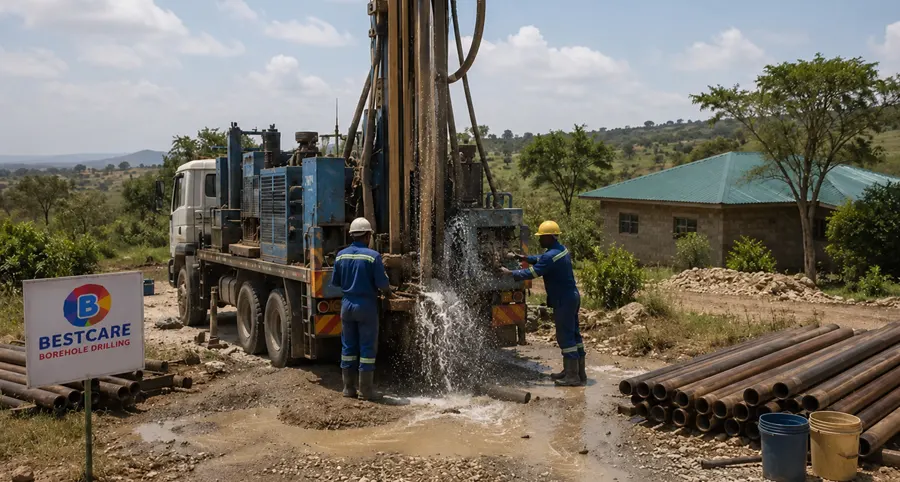
Where soil conditions don’t hold water naturally, or where farmers need controlled, low-seepage storage for irrigation or livestock, a geo-membrane reservoir offers a reliable alternative to earth dams or open ponds that leak. Bestcare Borehole Drilling installs lined water ponds using durable geo-membrane liners designed to hold large water volumes with minimal loss over years of use.
This kind of storage has become increasingly common on farms looking to capture rainwater or borehole output during high-flow periods for use later in dry spells.
Processes Involved in Lined Pond / Geo-membrane Reservoir Installation
| # | Process | What It Involves |
|---|---|---|
| 1 | Site & Capacity Assessment | Evaluating location, soil, and required storage volume |
| 2 | Pond Design & Sizing | Calculating dimensions, depth, and slope for stability |
| 3 | Excavation & Ground Preparation | Digging the pond basin and preparing a smooth base |
| 4 | Liner Selection & Installation | Choosing membrane grade and fitting it to the excavated basin |
| 5 | Inlet, Outlet & Overflow Fitting | Connecting supply and drawdown points |
| 6 | Testing & Commissioning | Fill testing and inspection for leaks or liner damage |
1. Site & Capacity Assessment
We assess the proposed site for slope, soil stability, and accessibility for both construction equipment and later water extraction. Required storage capacity is calculated against irrigation, livestock, or household demand the pond needs to support.
2. Pond Design & Sizing
Pond dimensions, depth, and side-slope angles are calculated to balance storage volume against excavation cost and structural stability. Side slopes in particular need careful design since too steep a slope risks liner damage and bank collapse over time.
3. Excavation & Ground Preparation
Excavation follows the approved design, after which the basin is cleared of sharp stones, roots, or debris that could puncture the liner. A smooth, compacted base is essential, since even a small tear in the membrane can lead to significant seepage over time.
4. Liner Selection & Installation
We select geo-membrane grade (typically HDPE) based on expected UV exposure, water depth, and durability requirements. The liner is fitted across the entire basin with properly welded or overlapped seams, and anchored securely at the pond edges to prevent slippage or wind lift.
5. Inlet, Outlet & Overflow Fitting
Once the liner is in place, we fit inlet piping for filling, an outlet point for extraction (often connected to a pump for irrigation or livestock use), and an overflow outlet to safely manage excess water during heavy inflow periods without damaging the liner or surrounding banks.
6. Testing & Commissioning
The pond is filled gradually while checking for leaks, liner shifting, or seam failure. Once confirmed watertight, the client is briefed on maintenance basics, including keeping debris off the liner surface and monitoring water levels through seasonal changes.
Estimated Cost of Lined Pond / Geo-membrane Reservoir Installation
| Service | Estimated Cost (KES) |
|---|---|
| Site & capacity assessment | 8,000 – 15,000 |
| Excavation (per m³) | 300 – 600 |
| HDPE geo-membrane liner (per m²) | 350 – 600 |
| Inlet/outlet/overflow fitting | 20,000 – 50,000 |
| Small pond (500m³ capacity) | 400,000 – 700,000 |
| Larger pond (1,000m³+ capacity) | 900,000+ |
Costs depend on pond size, liner grade, excavation difficulty, and site terrain.
Frequently Asked Questions
1. How long does a geo-membrane liner typically last? Quality HDPE liners generally last 15–20 years when properly installed and protected from sharp debris or excessive UV exposure.
2. Can an existing unlined pond be retrofitted with a liner? Yes, provided the basin can be reshaped and cleared sufficiently to protect the liner once installed.
3. Is a lined pond better than an earth dam for small farms? For smaller storage needs where seepage loss would be significant, lined ponds are often more water-efficient than unlined earth dams.
4. What happens if the liner gets punctured? Small punctures can be patched on-site without draining the entire pond, provided the damage is identified and accessible.
5. Can a lined pond be used for both irrigation and livestock watering? Yes, with appropriate outlet design, a single pond can serve multiple uses, though separating access points helps maintain water quality for each purpose.
5 Reasons to Choose Bestcare Borehole Drilling
- Careful basin preparation — we treat ground prep as critical, not a step to rush through before laying the liner.
- Quality liner sourcing — we use durable, UV-resistant HDPE membranes built for long-term outdoor exposure.
- Leak testing before handover — ponds are gradually filled and inspected, not declared finished on installation alone.
- Full water system integration — pond design accounts for how the stored water will actually be extracted and used.
- Farm-scale experience — we’ve sized and built ponds across a range of farm sizes and water demand profiles.