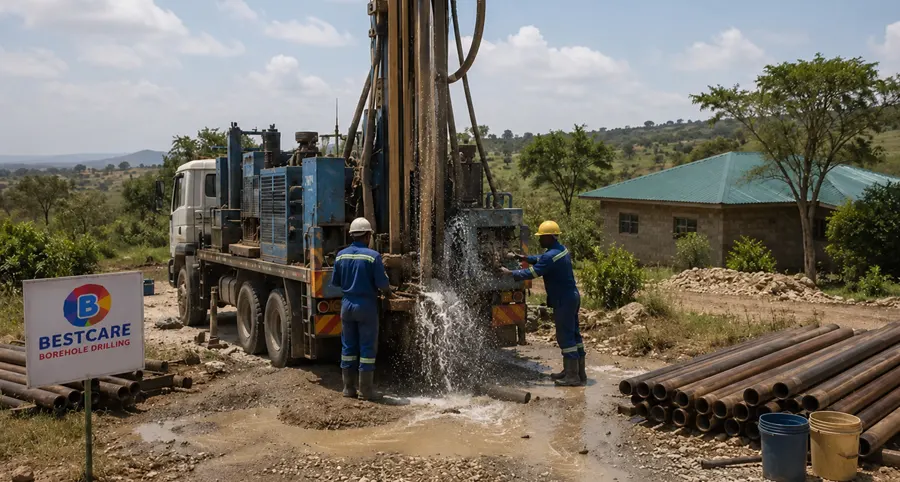
Solar Water Pumping Systems and Power Solutions
By Bestcare Borehole Drilling
Grid power in many parts of Nairobi and its outskirts is expensive, unreliable, or simply absent on farms and remote plots. That’s the gap solar water pumping systems fill, letting a borehole or surface water source run without a monthly electricity bill hanging over it. Bestcare Borehole Drilling designs and installs solar pumping setups sized to actual borehole yield and household or farm demand, not off-the-shelf kits that either underperform or waste money on oversized panels.
A properly sized solar power solution does more than just pump water. It accounts for sunlight hours specific to the site, backup options for cloudy days, and how the system integrates with existing storage tanks so water is still available even when the sun isn’t cooperating.
Processes Involved in Solar Water Pumping Installation
| # | Process | What It Involves |
|---|---|---|
| 1 | Load & Demand Assessment | Calculating daily water demand and required pumping capacity |
| 2 | Solar Resource & Site Assessment | Evaluating sunlight hours, shading, and panel placement options |
| 3 | Pump & Panel Sizing | Matching pump type and solar array size to borehole yield and depth |
| 4 | System Design & Component Selection | Choosing controllers, mounting structures, and backup provisions |
| 5 | Installation & Wiring | Physical mounting, cabling, and pump connection |
| 6 | Testing, Commissioning & Handover | Confirming output, safety checks, and client training |
1. Load & Demand Assessment
Every system starts with understanding actual water needs, whether that’s a household, livestock, or an irrigation block. We calculate daily litre requirements, peak demand periods, and how much storage capacity should buffer the gap between sunlight hours and usage patterns.
2. Solar Resource & Site Assessment
Not every spot on a plot is equal for solar. We assess shading from trees or structures, roof or ground-mount options, and orientation for maximum sun exposure across the day. This step also considers proximity to the borehole head to minimize cable and pipe runs.
3. Pump & Panel Sizing
This is the technical core of the project. Submersible solar pumps are matched against borehole depth, static water level, and confirmed yield from test pumping data, while panel array size is calculated against pump power draw and available sunlight hours. Undersizing here means a pump that can’t lift water reliably; oversizing wastes money on unnecessary panels.
4. System Design & Component Selection
Beyond the pump and panels, a complete design includes the controller (which regulates power delivery and protects the pump from dry-running), mounting frames rated for local wind conditions, and cabling sized for minimal voltage drop over distance. We also advise on hybrid setups combining solar with grid or generator backup for continuous supply.
5. Installation & Wiring
Physical installation covers panel mounting, controller and wiring installation, and pump lowering into the borehole with proper cable protection. All electrical connections are done to safe standards, with surge protection included given how exposed rooftop or ground-mounted arrays can be.
6. Testing, Commissioning & Handover
Once installed, we run the system through a full test cycle, confirming actual output against design expectations, checking controller function, and verifying storage tank filling under real conditions. Clients are walked through basic system operation and maintenance before handover.
Estimated Cost of Solar Water Pumping Systems
| Service | Estimated Cost (KES) |
|---|---|
| Load & site assessment | 5,000 – 10,000 |
| Solar submersible pump (1–2 HP) | 60,000 – 150,000 |
| Solar panel array (per kW installed) | 35,000 – 50,000 |
| Controller & mounting structure | 20,000 – 45,000 |
| Full installation & wiring | 15,000 – 30,000 |
| Complete system (small household setup) | 180,000 – 350,000 |
| Complete system (farm/commercial scale) | 400,000 – 900,000+ |
Costs vary significantly with borehole depth, required yield, and system scale.
Frequently Asked Questions
1. Can a solar pumping system run entirely without grid backup? Yes, for most residential and small farm applications, provided the panel array and storage tank are sized correctly for demand and sunlight availability.
2. What happens on cloudy or rainy days? A correctly sized storage tank buffers several days of demand, and hybrid systems with grid or generator backup can be added where continuous supply is critical.
3. How long do solar pumps typically last? Quality submersible solar pumps typically run 8–12 years with proper maintenance, while panels themselves are rated for 20–25 years.
4. Can an existing borehole with a grid-powered pump be converted to solar? Yes, most boreholes can be retrofitted, though depth and yield data should be reviewed to confirm the right pump and panel sizing for the conversion.
5. Does solar pumping cost more than grid-connected pumping long-term? Initial installation costs more, but with no monthly electricity bill, solar systems typically pay for themselves within 2–4 years depending on usage.
5 Reasons to Choose Bestcare Borehole Drilling
- Yield-matched sizing — pump and panel sizing is based on actual test pumping data, not generic assumptions.
- End-to-end integration — since we also handle drilling and equipping, solar systems are designed with full knowledge of the borehole’s real capacity.
- Hybrid backup expertise — we design for continuity, not just sunny-day performance.
- Quality component sourcing — controllers, mounts, and pumps are selected for durability under Kenyan field conditions, not lowest-cost imports.
- Post-installation support — ongoing servicing and troubleshooting keep systems running well past the initial installation.